This post contains affiliate links. If you buy through them, we may earn a small commission at no extra cost to you. It helps keep Tuxedo in chicken.
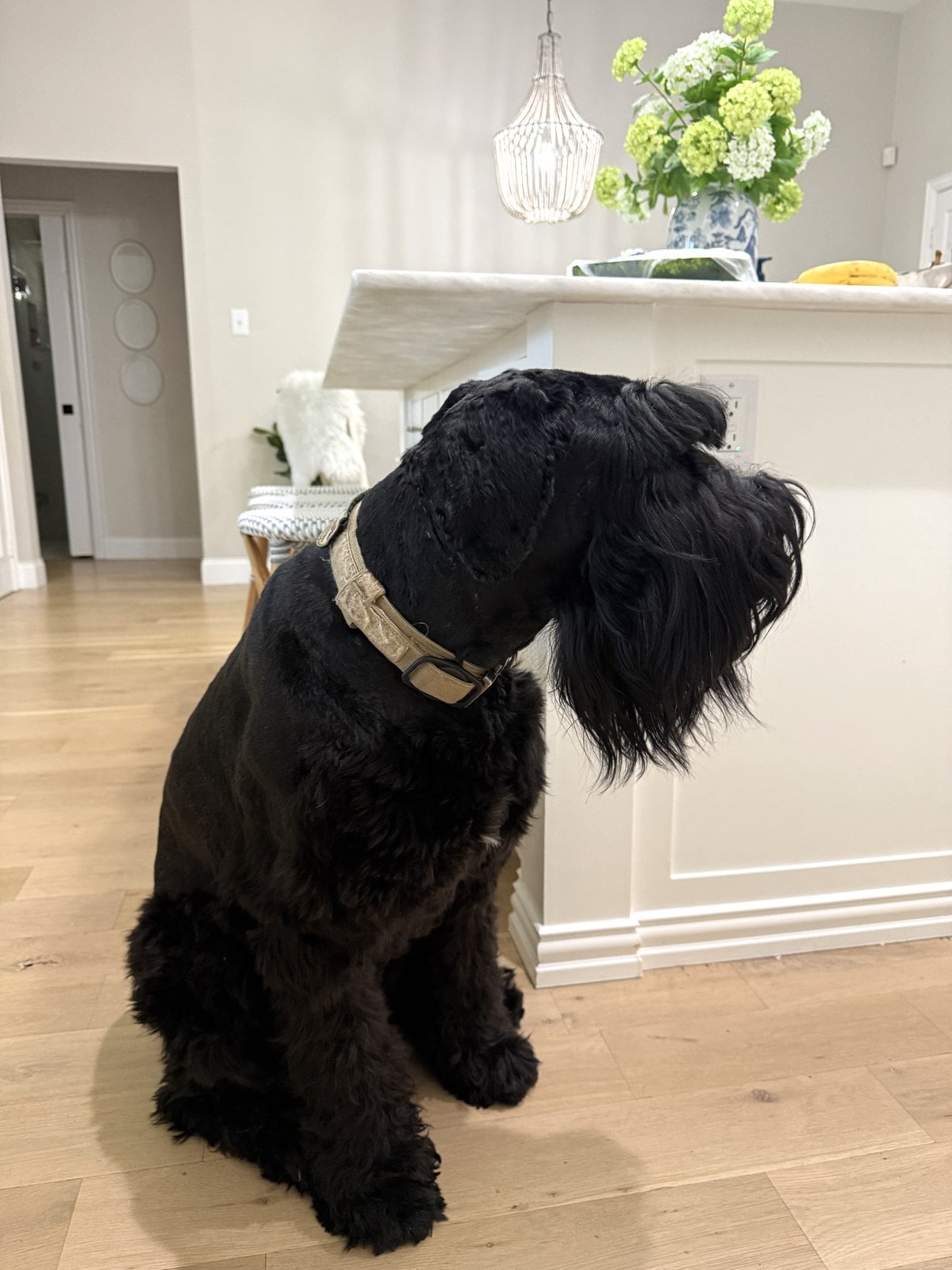
Tuxedo, our 105-pound Giant Schnauzer, treats dinner like a timed event. The bowl goes down, and roughly forty seconds later he is looking at us as if food never happened. For a long time we thought it was funny. Then we learned what fast eating actually does to dogs his size, and it stopped being funny at all.
The problem has a name: bloat
Bloat — the medical name is gastric dilatation-volvulus, or GDV — is the emergency where a dog’s stomach fills with gas and can twist on itself. The American College of Veterinary Surgeons calls it a “rapidly progressive life-threatening condition” that needs immediate medical attention, with reported mortality around 15% even with treatment — and worse the longer it goes untreated. It is not rare bad luck: VCA Animal Hospitals puts the lifetime risk for dogs over 100 pounds at approximately 20%. One in five. That number is why every giant-breed owner ends up learning this word.
The classic candidate is exactly the dog sleeping in our living room: large, deep-chested breeds. Great Danes, Saint Bernards, Weimaraners, standard poodles — and while Giant Schnauzers don’t headline the lists, the risk factors are about size and chest shape, and a 105-pound schnauzer with a deep chest checks both boxes.
Where eating speed comes in
You can’t change your dog’s chest shape. Eating speed is one of the few risk factors you can actually do something about. The American Kennel Club states it flatly: “Fast eaters have five times the risk than dogs that are slow eaters” — and its prevention advice specifically includes slow feeder bowls. VCA lists rapid eating among the risk factors too, alongside feeding one big meal a day instead of several smaller ones. The pattern across the veterinary sources is consistent: a dog that vacuums a large single meal, gulping air with it, is the dog you worry about.
The $10 fix we found
Full transparency up front: we researched this one, we haven’t tested it ourselves. But the Outward Hound Fun Feeder Slo Bowl (Large) is about as close to a consensus pick as dog gear gets: 4.6 stars across more than 135,000 ratings when we checked on August 27, 2026, at $10.29.
What made it our pick for a giant breed, beyond the ratings: the large size holds a full 4 cups, so an actual giant-dog meal fits — a lot of slow feeders are built for beagles. The maze forces the dog to work around ridges instead of scooping mouthfuls, which the manufacturer says slows eating by up to 10x (their number, not an independent one — but the mechanism is obvious the moment you look at it). It has a non-slip base, which matters when 105 pounds of determination is pushing a bowl around the kitchen, and it goes in the top rack of the dishwasher, which with a bearded dog is not optional.
If you have a heavy chewer: Feedoo Stainless Slow Feeder (~$30)
Some big dogs treat plastic bowls as a chew toy with extra steps. This stainless steel slow feeder (4.5 stars when we checked) costs more, but steel solves the chewing problem and some owners simply prefer it for cleaning. Same idea, tougher material. We haven’t tested this one either — it earned its spot on specs and ratings.
What a slow feeder does NOT do
Honesty section. A slow feeder is not a bloat cure and nobody serious claims it is. The surgeons’ college notes that for the highest-risk breeds, many veterinary surgeons now recommend a preventive surgery called prophylactic gastropexy — that is a conversation to have with your vet, not a bowl purchase. The bowl addresses one modifiable risk factor. The other cheap ones the sources point to: feed two or more smaller meals instead of one big one, and know the emergency signs (unproductive retching, a swollen tight belly, sudden distress) — because with bloat, hours decide outcomes.
The checklist, whatever bowl you buy
Capacity for a real meal — a giant breed needs the large size, not the cute one. Ridges tall enough to actually slow a big muzzle — shallow mazes are decoration for a dog with a jaw like Tuxedo’s. Non-slip base, or the bowl will tour the kitchen. Dishwasher-safe, because a maze you can’t clean becomes a science experiment. And watch the first few meals — a frustrated dog that flips the bowl needs an easier maze level, not a return to gulping.
Sources
1. VCA Animal Hospitals — Bloat: Gastric Dilatation and Volvulus in Dogs: https://vcahospitals.com/know-your-pet/bloat-gastric-dilatation-and-volvulus-in-dogs
2. American College of Veterinary Surgeons — Gastric Dilatation-Volvulus: https://www.acvs.org/small-animal/gastric-dilatation-volvulus/
3. American Kennel Club — Bloat (or GDV) in Dogs: https://www.akc.org/expert-advice/health/bloat-in-dogs/
4. Amazon product listings for the Outward Hound Fun Feeder (Large) and Feedoo stainless slow feeder, prices and ratings accessed August 27, 2026.
Leave a Reply