This post contains affiliate links. If you buy through them, we may earn a small commission at no extra cost to you. It helps keep Tuxedo in tennis balls.
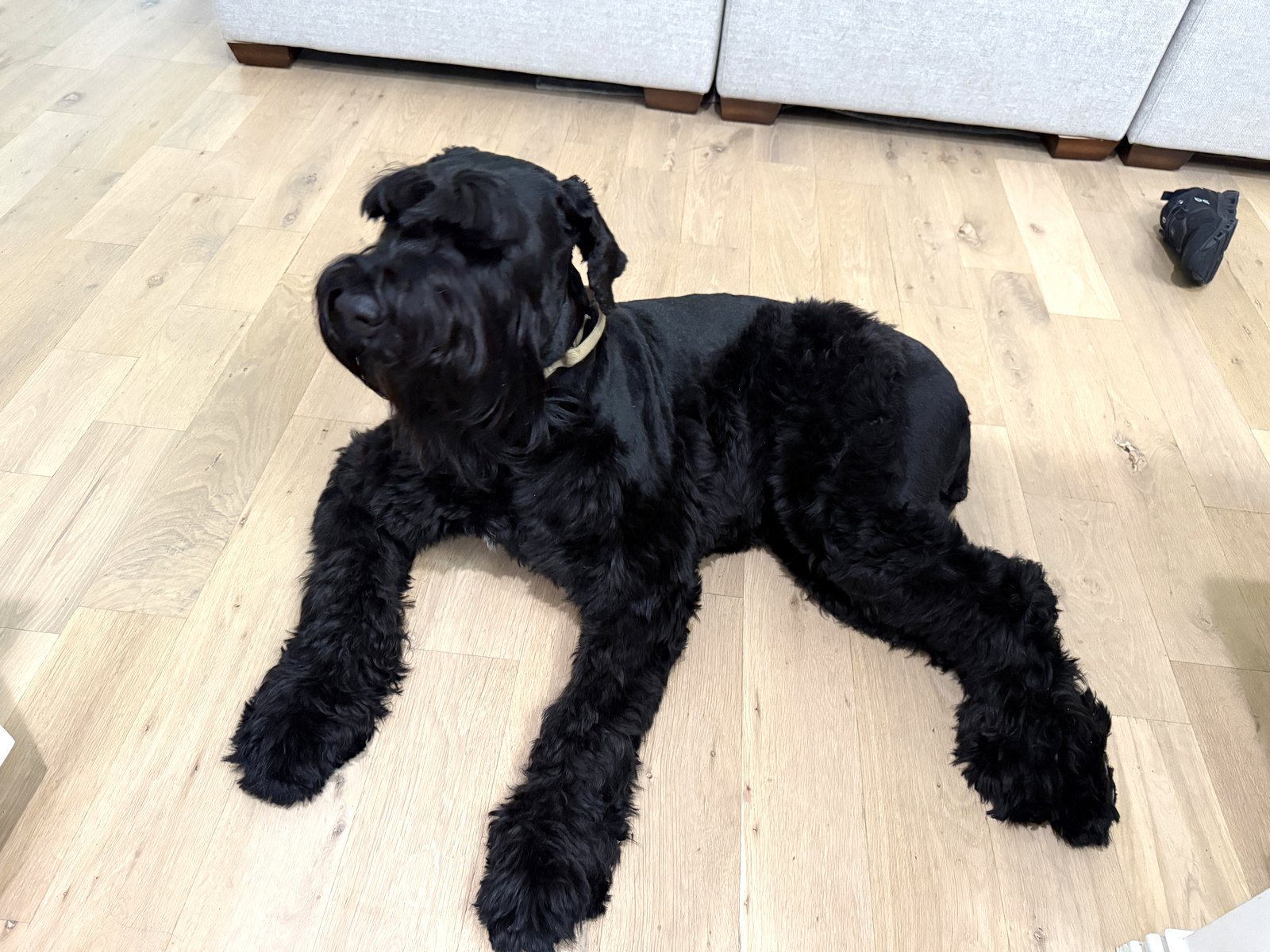
Tuxedo is 105 pounds of Giant Schnauzer, and every one of those pounds lands on four joints every time he launches off the couch like it owes him money. Watching a giant breed get older is watching physics collect its bill: the bigger the dog, the more load his hips, elbows, and knees carry through every jump, every zoomie, every slow lap around the kitchen hoping something falls off the counter. So when we kept seeing one joint supplement sitting in Amazon’s dog supply best-sellers — Nutramax Cosequin, with just under 80,000 ratings — we wanted to answer the question every big-dog owner eventually types into a search bar: do joint supplements for large breed dogs actually work, or are we buying $35 of hope?
The joint problem is real — especially for big dogs
This part is not hype. According to VCA Animal Hospitals, osteoarthritis (OA) affects at least 20% of dogs over one year old and 80% of dogs over eight years old [1]. That is not a “senior dog” problem — one in five dogs barely out of puppyhood already has some degree of it.
Size makes it worse. The American College of Veterinary Surgeons notes that hip dysplasia — the loose, unstable hip joint that grinds cartilage into bone spurs and arthritis — occurs most commonly in large breed dogs, with genetics as the greatest single risk factor and rapid growth from overfeeding making it worse [2]. Giant breeds like Tuxedo essentially start the game on hard mode: more genetic risk, more weight per square inch of cartilage, more years of wear compressed into a shorter lifespan.
The early signs are easy to miss because big dogs hide them well: slower to get up off the floor, walking beside you instead of ahead of you, hesitating before stairs or the jump into the truck, and shifting weight off one leg [1]. If any of that sounds familiar, the first stop is your vet — not Amazon.
What the science actually says about joint supplements
Here is the honest part most product roundups skip. VCA’s veterinary review of joint nutraceuticals says it plainly: despite the popularity of glucosamine/chondroitin supplements, research to support definitive benefits has yet to be available. The same review notes that low-molecular-weight chondroitin does appear to have a positive effect in some dogs — but not all dogs will benefit, so a supplement is best treated as a trial, not a cure [3].
Meanwhile, two things have much stronger evidence behind them, and both are cheaper than any bottle of chews:
- Keeping your dog lean. Body fat isn’t just extra load — it actively secretes inflammatory hormones that contribute to chronic joint pain. Research has clearly demonstrated this link, which is why weight control is the single most powerful thing an owner controls [4].
- Omega-3 fatty acids (EPA/DHA). VCA calls it well known that a diet rich in EPA and DHA can help modify chronic joint inflammation — with the caveat that the dose has to be high enough to matter, which many foods and cheap fish oils don’t reach [4].
So why is Cosequin the one everyone buys?
If you and your vet decide a glucosamine/chondroitin trial is worth running, the version we kept landing on in our research is Nutramax Cosequin chewable tablets with MSM (132 count) — $34.91 at the time of writing, rated 4.7 stars across 79,622 ratings, and sitting in Amazon’s dog supply best-sellers list [5].
Full transparency: Tuxedo doesn’t take it, and we haven’t tested it ourselves. But there are practical reasons it dominates this category. Nutramax is a veterinary-focused manufacturer, the tablets are dosed by weight ranges that actually go up to the giant-breed sizes (a 105-pound dog needs a real dose, not a chihuahua chew), and the 132-count bottle works out to a reasonable cost per month for a big dog once you’re past the initial loading period. In a supplement category with famously loose quality control, “made by a company vets actually know” is worth something.
What it is not: a painkiller, a treatment for hip dysplasia, or a substitute for a diagnosis. VCA’s guidance is to ask your veterinarian about the scientific data behind any nutraceutical they recommend [1] — that conversation costs nothing and is the difference between a supplement trial and $35 of wishful thinking.
The evidence-first order of operations
- Vet exam first — limping, stiffness, and slow rises have many causes, and OA is diagnosed by a physical exam, not a hunch [1].
- Get the weight right — the highest-evidence, lowest-cost intervention there is [4].
- Ask about omega-3s — EPA/DHA at an effective dose, ideally one your vet signs off on [4].
- Then consider a supplement trial — like Cosequin, understanding some dogs respond and some don’t [3].
Buyer checklist for any joint supplement
- Dosing chart covers your dog’s actual weight (giant breeds often need double the “large dog” dose)
- Made by a manufacturer with veterinary distribution, not just a label
- Your vet has seen the ingredient list and agreed it’s worth a trial
- You commit to a fair trial window and actually watch for changes (getting up, stairs, willingness to jump)
- You’re fixing weight and exercise at the same time — a supplement can’t out-chew a heavy dog
Sources
- VCA Animal Hospitals — Arthritis in Dogs: https://vcahospitals.com/know-your-pet/arthritis-in-dogs (accessed 8/28/2026)
- American College of Veterinary Surgeons — Canine Hip Dysplasia: https://www.acvs.org/small-animal/canine-hip-dysplasia/ (accessed 8/28/2026)
- VCA Animal Hospitals — Nutraceuticals for Joint Support in Dogs with Osteoarthritis: https://vcahospitals.com/know-your-pet/nutraceuticals-for-joint-support-in-dogs-with-osteoarthritis (accessed 8/28/2026)
- VCA Animal Hospitals — Arthritis and Nutrition for Dogs: https://vcahospitals.com/know-your-pet/arthritis-and-nutrition-for-dogs (accessed 8/28/2026)
- Amazon product listing — Nutramax Cosequin Joint Supplement for Dogs, Chewable Tablets, 132ct: price, rating, and review count as of 8/28/2026
Leave a Reply