This post contains affiliate links. If you buy through them, we may earn a small commission at no extra cost to you. It helps keep Tuxedo in tennis balls.
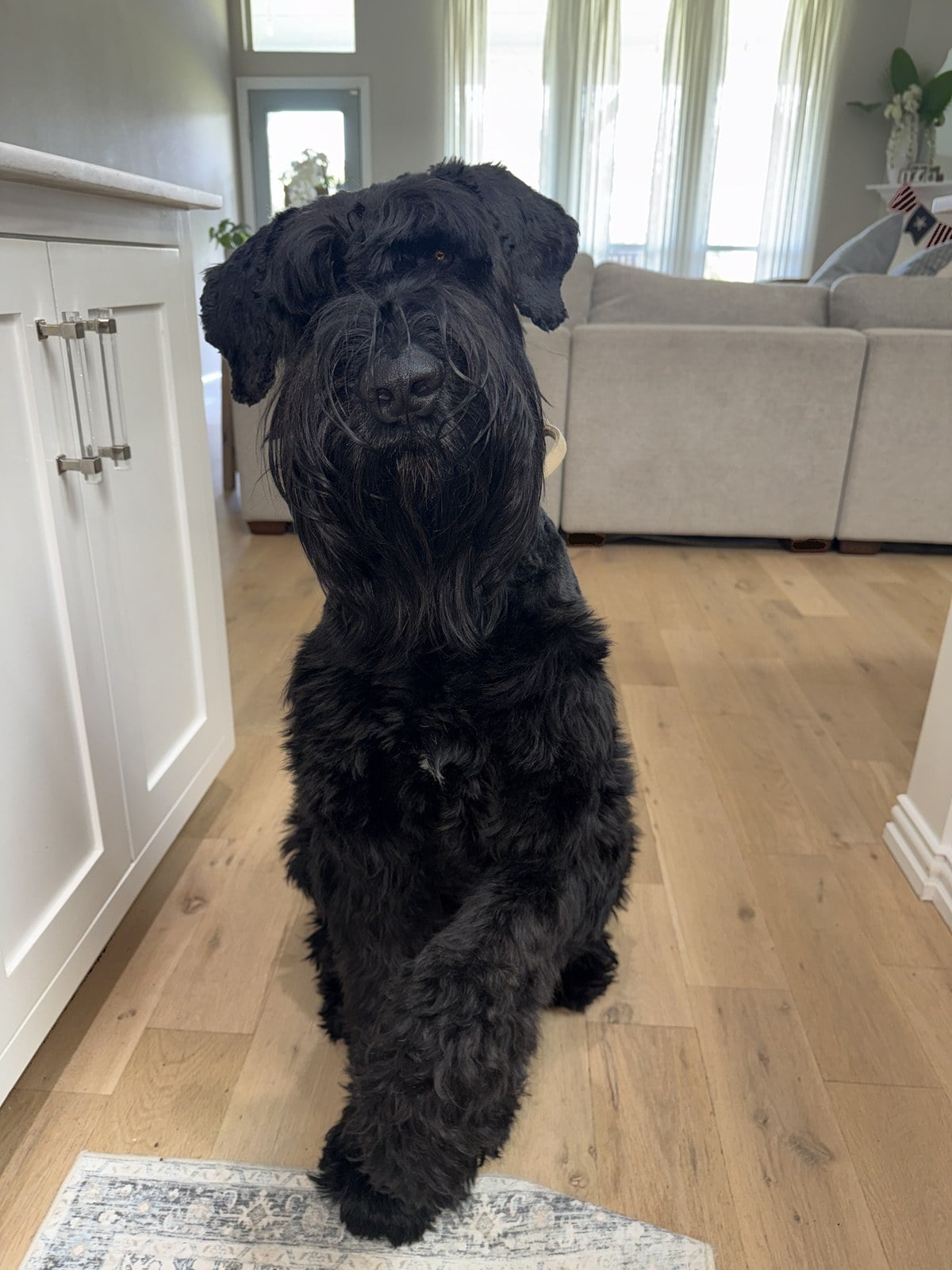
Giant Schnauzers were bred to run a farm — drive cattle, guard the yard, generally hold down a full-time job. Tuxedo’s current position is unemployed house dog, and on the days we don’t give him something to do, he opens his own projects. Recent ones include quality-testing a couch cushion and stirring his dinner with his nose because we didn’t mix it to his standards. It turns out this isn’t a personality quirk — it’s exactly what the behavior experts say happens when a working brain has no work. The fix we went looking for costs less than a bag of treats.
A bored dog makes his own fun
The AKC’s training experts put it plainly: a bored dog will make their own fun, most likely in ways that don’t work for you — chewed furniture and shoes, shredded pillows, dug-up backyards, tipped trash cans, and barking with no off switch [1]. And the bigger and more work-bred the dog, the bigger the projects. Different breeds were bred for different jobs, and a dog from working lines needs an outlet for the drive that job used to absorb [1]. Their bottom line: giving your dog’s brain a workout is as important as exercising their body [1].
Dogs would rather work for dinner
Here’s the part that genuinely surprised us: VCA Animal Hospitals cites research showing dogs actually prefer to work for food rather than receive it for free [2]. Foraging is on VCA’s list of natural behaviors that need a daily outlet, and in one study, kenneled dogs given food-dispensing toys barked less and were more active than dogs without them [2]. VCA specifically recommends food puzzles for pets that eat too quickly and for pets that are overweight or inactive [2] — which describes half the giant breeds we know, Tuxedo’s food-inhaling phase included.
The puzzle 49,000 dog owners rated
The category classic is the Outward Hound Nina Ottosson Dog Brick — $14.30 at the time of writing, rated 4.5 stars across a remarkable 49,606 ratings [3]. Nina Ottosson is the Swedish designer who more or less invented the dog-puzzle category, and the Brick is her intermediate Level 2 design. Full transparency: we researched this one and it’s joining Tuxedo’s rotation; the report on how fast a Giant Schnauzer defeats Swedish engineering will follow.
Why it fits what the experts describe: it’s a 3-in-1 challenge — flip open lids, slide covers, and lift out bone-shaped pieces to uncover hidden treat compartments — with difficulty you can adjust as your dog learns the game [3]. It holds regular kibble, so it can replace the bowl entirely and double as a slow feeder [3], which is precisely the working-for-dinner setup VCA describes [2]. The maker’s claim is that 15 minutes of brain-engaging play equals 30 minutes of physical activity [3] — their number, not a vet’s, but it tracks with why the AKC ranks brain work alongside exercise [1].
The honest catches
- It’s a supervised toy, not a chew toy. It’s hard plastic with removable pieces — a determined giant-breed jaw can turn puzzle pieces into shrapnel. Play together, then put it away.
- Smart dogs solve it fast. A clever dog can clear the board in minutes once trained up. The AKC’s fix applies here: rotate toys so an old puzzle feels new again [1], and make it harder by covering compartments with the sliders and bones stacked.
- Puzzle calories are still calories. If you load it with treats on top of full meals, you’ve invented a device that fattens your dog intelligently. Use part of the daily kibble ration — the slow-feeder mode is the point [2][3].
- It’s one tool, not the whole job. A working breed still needs walks, training, and sniffing time — VCA lists a whole menu of free enrichment, from kibble in a muffin tin to food scattered for a find-it game [2]. The puzzle is the easy button, not the only button.
Buyer checklist for a dog puzzle toy
- A difficulty level that matches your dog — start intermediate for a clever breed, easier for a first-timer [3]
- Multiple mechanics (lids, sliders, lift-out pieces) so the game doesn’t have one solution [3]
- Kibble-compatible, so it can replace bowl meals instead of adding treat calories [2][3]
- Supervised sessions and a rotation habit — novelty is half the enrichment [1]
- Daily brain work on the schedule, same as the walk — the AKC treats them as equals [1]
Sources
- American Kennel Club (Stephanie Gibeault, MSc, CPDT) — Bored Dogs: How to Recognize and Solve Doggy Boredom: https://www.akc.org/expert-advice/training/bored-dogs-how-to-recognize-doggy-boredom-and-help/ (accessed 9/12/2026)
- VCA Animal Hospitals — Enriching Your Pet’s Environment with Their Food: https://vcahospitals.com/know-your-pet/enriching-your-pets-environment-with-their-food (accessed 9/12/2026)
- Amazon product listing — Outward Hound Nina Ottosson Dog Brick (Level 2): price, rating, review count, and product claims as of 9/12/2026
Leave a Reply