This post contains affiliate links. If you buy through them, we may earn a small commission at no extra cost to you. It helps keep Tuxedo in tennis balls.
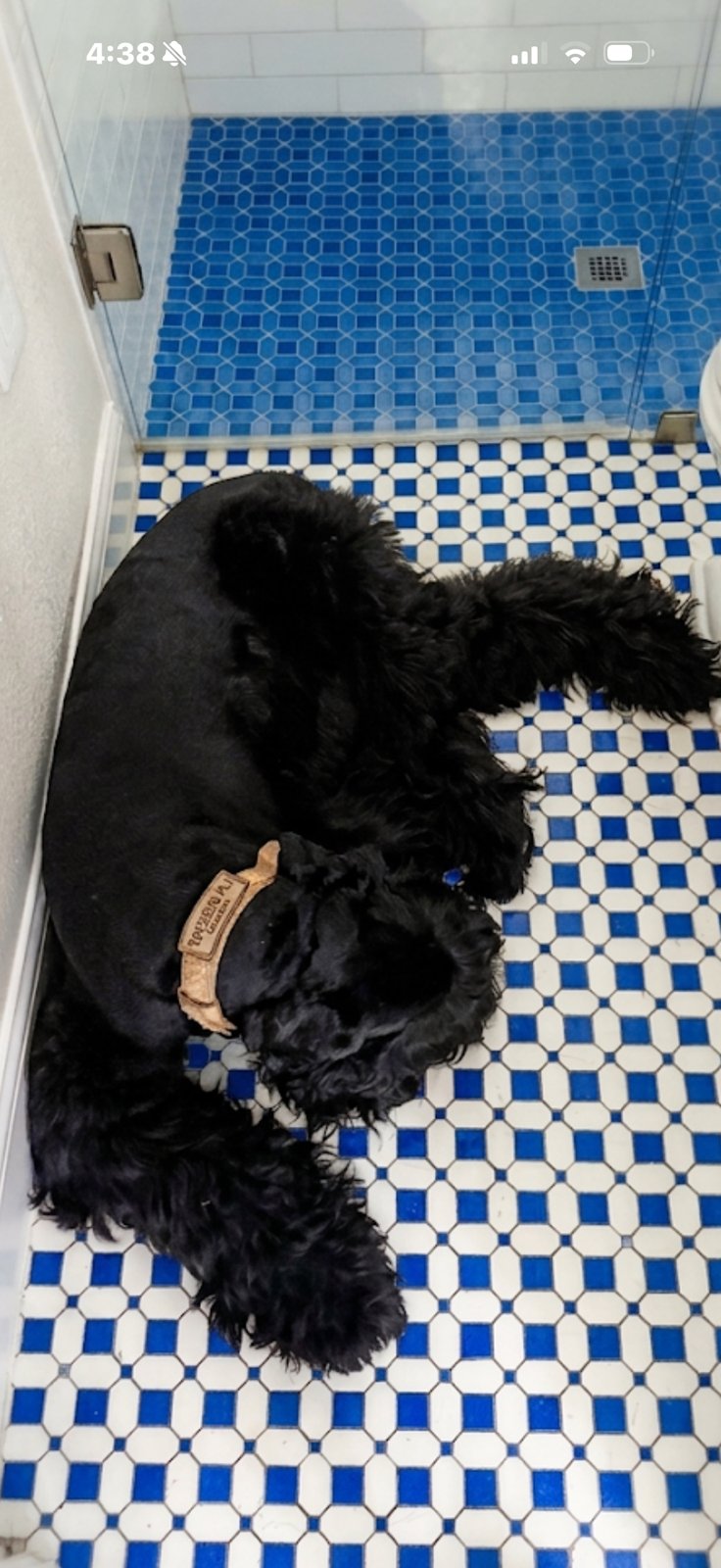
Yesterday we finally fixed what goes in the bath — a pH-balanced dog shampoo instead of whatever’s on the shower shelf. Then Tuxedo stepped out of the tub and reminded us about the other half of bath day: 105 pounds of Giant Schnauzer in a dense curly coat that holds water like a sponge, shaking a gallon of it onto the walls and then air-drying for the next six hours. We’d been treating the wet part as a towel-and-hope situation. It turns out vets treat a coat that stays wet as an actual medical problem — and the ordinary cotton bath towel we’d been sacrificing to the cause was barely making a dent.
Why a wet coat is more than a wet floor
The problem has a name: hot spots — painful, fast-growing patches of infected skin, and moisture is one of their favorite starting points. The AKC’s veterinary guidance is direct about it: dogs that are frequently wet from swimming, bathing, or bad weather are more prone to hot spots because of the excess moisture held against the skin by their coats, and the risk climbs in warm, humid weather [1]. The breeds on the AKC’s watch list are exactly the big, thick-coated ones — Golden Retrievers, St. Bernards, German Shepherds, Labs, Rottweilers [1]. A dense-coated giant breed checks every box.
VCA Animal Hospitals explains the mechanism: fur that traps water after a swim or a soaking keeps the skin underneath wet, and a coat that never fully dries creates what they call a perfect environment for a hot spot [2]. The prevention advice from the AKC is almost embarrassingly simple: for dogs that swim or get bathed regularly, make sure the coat is thoroughly dry after each session [1]. Simple to say — less simple when the dog in question has the coat density of a sheep and the patience of a toddler.
Why the cotton bath towel loses
A regular cotton towel mostly pushes water around a thick double coat — it soaks through in a minute, and then you’re rubbing a wet towel on a wet dog. That’s how a “quick dry” turns into a damp dog lying on the couch for the rest of the evening, which is precisely the scenario the vet sources say to avoid [1][2]. What you want is a purpose-built drying tool: more absorbent material, a shape you can actually control on a moving animal, and something that dries out fast enough to be ready for round two.
The shammy built for dirty dogs
The best-reviewed option we found is the Dog Gone Smart Dirty Dog Shammy — $19.97 at the time of writing, rated 4.7 stars across 4,409 ratings and sitting at #20 in Dog Shower & Bath Supplies [3]. Full transparency: we researched this one and it’s joining Tuxedo’s bath kit alongside yesterday’s shampoo pick; the long-term curly-coat verdict will follow.
Why it beats the bathroom towel on the spec sheet: it’s a 1500 GSM microfiber blend the maker says traps up to 8 times its weight in water and dries a dog 10 times faster than ordinary cotton towels [3]. It has dual hand pockets with elastic — you wear it like a pair of mitts, which on a dog who treats towel time as a wrestling match is the difference between drying him and chasing him. The fabric carries EPA-approved anti-microbial technology to keep the towel itself from developing that permanent wet-dog smell between washes, and the whole thing is machine washable [3]. At 31 by 13 inches it’s sized as a working shammy, not a bedsheet — for a giant breed, plan on wringing it out mid-dry, which is exactly what it’s built for.
The honest catches
- One shammy, one giant dog. 31×13 inches is a hand tool, not a wrap. It out-absorbs a cotton towel by a wide margin, but on a 100-pound dog you’ll still wring and repeat — or keep two in rotation.
- A towel can’t fix a mat. VCA’s warning is specifically about matted fur trapping water against the skin [2]. If the coat is matted, the moisture stays no matter what you dry with — brushing out the coat (our slicker brush pick covers this) comes first.
- An existing hot spot is a vet visit. These sores are painful and spread fast; the sources treat prevention and treatment as different jobs. A drying towel prevents; it does not treat [1][2].
- Microfiber has a learning curve. Blot and squeeze the coat rather than scrubbing in circles — dense curly coats tangle, and aggressive rubbing invites the mats you’re trying to avoid.
Buyer checklist for a dog drying towel
- High-GSM microfiber, not cotton — absorbency is the whole job [3]
- Hand pockets or a mitt design so the towel moves with you, not off the dog [3]
- Machine washable, with odor control if it lives in the truck [3]
- A thorough-dry habit after every bath, swim, and rainstorm — that’s the actual vet advice [1]
- A mat-free coat underneath, so there’s nowhere for water to hide [2]
Sources
- American Kennel Club (Elizabeth Racine, DVM) — Hot Spots on Dogs: Signs, Treatment, and Prevention: https://www.akc.org/expert-advice/health/hot-spots-on-dogs/ (accessed 9/11/2026)
- VCA Animal Hospitals — Hot Spots in Dogs: https://vcahospitals.com/know-your-pet/hot-spots-in-dogs (accessed 9/11/2026)
- Amazon product listing — Dog Gone Smart Dirty Dog Shammy (31×13 in): price, rating, review count, category rank, and product claims as of 9/11/2026
Leave a Reply