This post contains affiliate links. If you buy through them, we may earn a small commission at no extra cost to you. It helps keep Tuxedo in tennis balls.
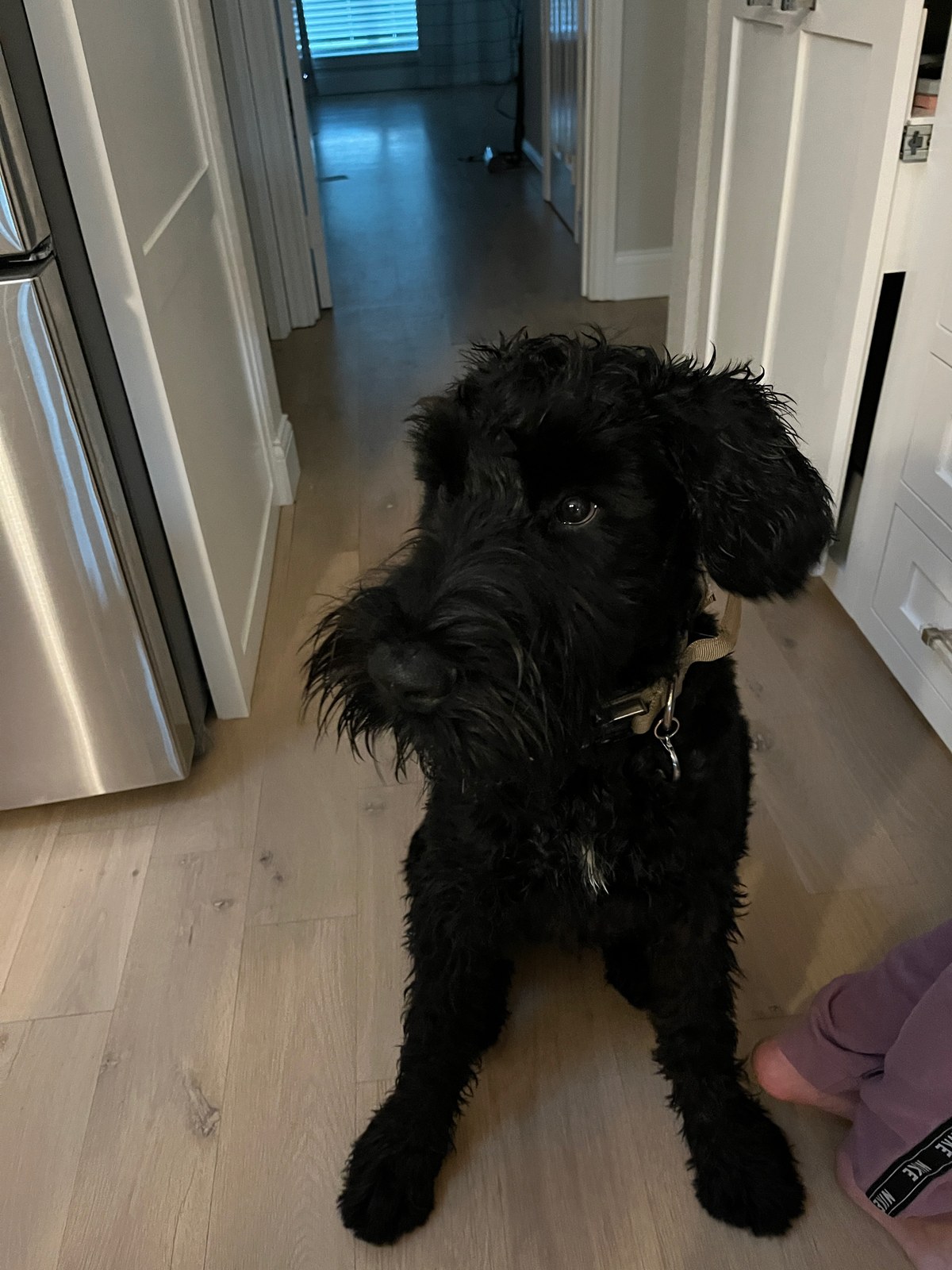
Here’s a physics problem nobody warns you about when you bring home a giant breed: when 105 pounds of Giant Schnauzer sees a squirrel, one of you is going where the other one decides — and it’s not always the one holding the leash. For the first stretch of Tuxedo’s leash career, every pull ended the same way: all of that force concentrated on a two-inch strip of collar against his throat, and a shoulder workout for me. It turns out both halves of that problem have the same fix, and it costs about twenty bucks.
Why the collar is the wrong place for that force
Dogs pull for the simplest reason imaginable — VCA Animal Hospitals puts it bluntly: dogs pull to get where they are going, and they’d like to get there considerably faster than we walk [1]. The trouble is where the counter-force lands. The AKC notes that a harness can prevent potential throat damage in a dog that pulls, which is exactly the damage a flat collar invites when the puller weighs as much as a middle-schooler [2]. VCA adds a warning about the “stronger collar” instinct: training collars — slip, choke, prong, electronic — work by causing neck pain, and some dogs are injured by heavy collar pressure [1]. More neck pressure isn’t a training plan; it’s a vet bill on layaway.
The front clip is the whole trick
The equipment both sources point to instead is a harness with a chest attachment. The mechanics matter: clip the leash to a dog’s back and you’ve built a sled-dog rig — pulling actually feels productive. Clip it to the chest, and the AKC explains the leverage flips: when the dog surges, the front attachment turns him back toward you instead of letting him lean into the pull, with the pressure landing on the chest rather than the neck [2]. VCA’s equipment guidance matches: an H-style or Y-style harness with free shoulder movement and both front and back attachment points, with the front clip doing the anti-pull work [1].
For truly powerful dogs, both sources note a head halter offers even more control — but it needs a careful, gradual introduction, which makes the front-clip harness the practical starting point for most big-dog owners [1][2].
The harness 197,000 dog owners landed on
The category giant is the rabbitgoo No-Pull Dog Harness — $19.98 at the time of writing, rated 4.5 stars across a staggering 197,067 ratings, sitting at #2 in Dog Vest Harnesses [3]. The listing even names Giant Schnauzers on its recommended-breed list, which we choose to take personally [3]. Full transparency: we researched this one; it’s on order for Tuxedo and the long-term verdict will come after he’s tried to tow me with it.
Why it fits the expert criteria: it has two metal leash rings — the chest clip for no-pull training walks, the back clip for casual walks and jogging — matching the dual-attachment setup VCA describes [1][3]. It goes on overhead with two quick-release buckles, has padded straps rather than thin webbing, reflective strips for early-morning walks, and a grab handle on the back — which, on a dog big enough to have opinions, is a feature you use more than you’d think [3].
The honest catches
- The harness manages pulling; it doesn’t train it away. VCA’s actual fix is training: stop moving the moment the leash goes tight, reward slack, repeat forever [1]. The front clip just makes the training winnable against a big dog.
- Fit is everything. Measure neck and chest girth before ordering — a loose harness on a strong dog is an escape artist kit, and a tight one chafes behind the front legs.
- Watch the shoulder strap placement. The reason VCA specifies H- or Y-style is free shoulder movement [1] — a strap that cuts across the shoulder can alter a dog’s gait over long daily miles.
- A determined giant breed can still move you. The front clip helps enormously; it does not repeal physics. For dogs beyond it, ask your vet or trainer about a properly introduced head halter [1][2].
Buyer checklist for a big-dog no-pull harness
- A front chest clip AND a back clip — metal rings, not plastic [1][3]
- H- or Y-style fit that leaves the shoulders free to move [1]
- Padded straps and real stitching — thin webbing saws into a heavy chest
- A back handle for close control in parking lots and vet lobbies
- Measured fit from actual neck and girth numbers, plus the stop-and-reward training habit that does the real work [1]
Sources
- VCA Animal Hospitals — Controlling Pulling on Walks: https://vcahospitals.com/know-your-pet/controlling-pulling-on-walks (accessed 9/4/2026)
- American Kennel Club — Dog Harnesses and Dog Collars: Which Is Right for Your Dog?: https://www.akc.org/expert-advice/training/dog-harness-vs-collar/ (accessed 9/4/2026)
- Amazon product listing — rabbitgoo No-Pull Dog Harness (Large): price, rating, review count, category rank, and product claims as of 9/4/2026
Leave a Reply