This post contains affiliate links. If you buy through them, we may earn a small commission at no extra cost to you. It helps keep Tuxedo in tennis balls.
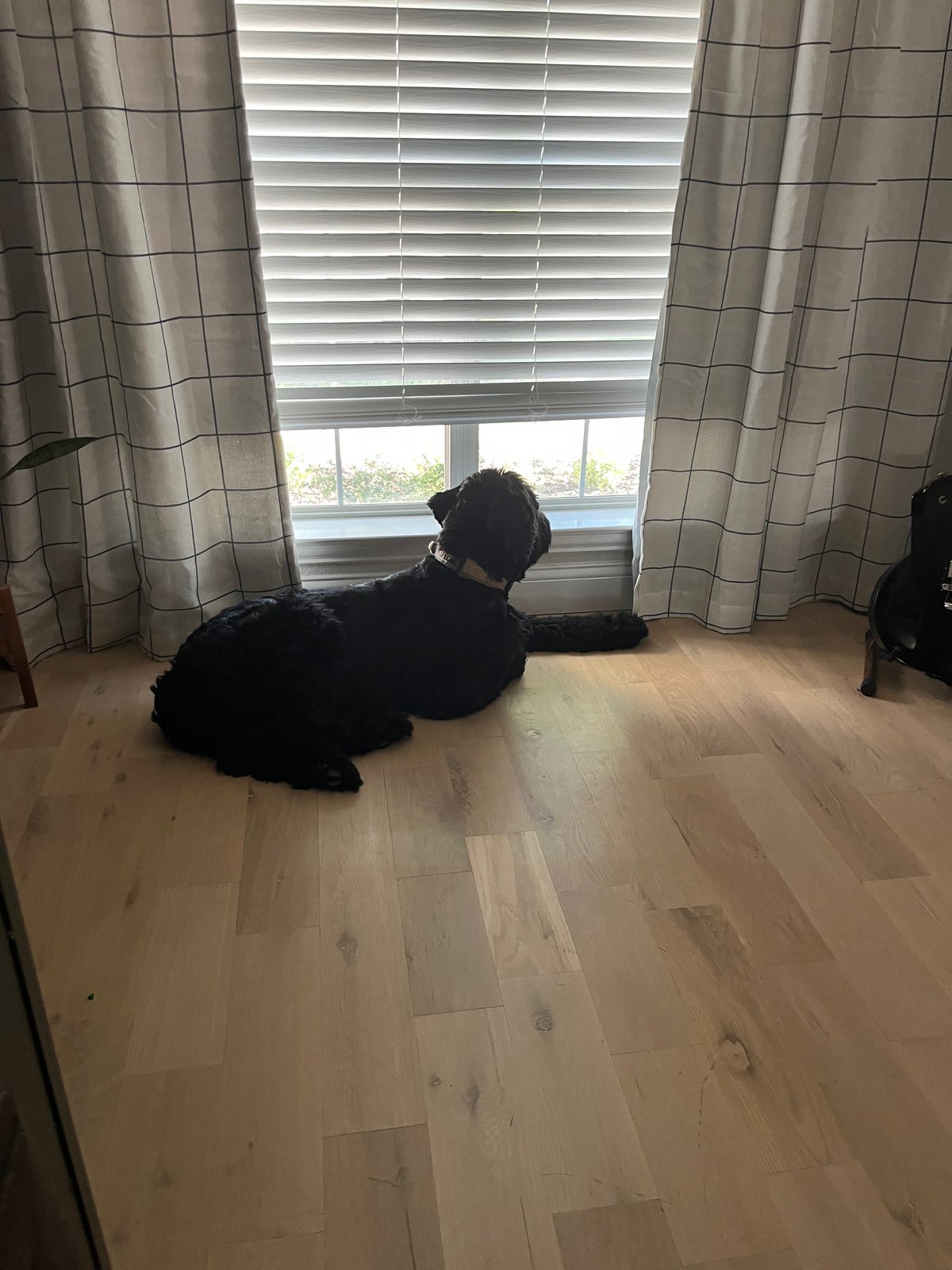
Day two of chicken diplomacy at our house. Yesterday we fixed treat delivery — the pouch is on the belt, rewards arrive on time. Today’s problem is distance. Because here is the uncomfortable truth about training a 105-pound Giant Schnauzer to be polite around backyard poultry: on a six-foot leash he isn’t choosing to stay calm, he’s just out of options. And off leash, we’d be betting the chickens’ lives on a working breed’s impulse control. What we actually needed was the boring middle ground professional trainers have used forever — a long training line. Ours cost ten dollars, it’s thirty feet of blaze-orange nylon, and it has quietly become the most important piece of gear in the yard.
Why recall is the whole ballgame
The AKC’s off-leash readiness guidance sets the bar clearly: before a dog earns real freedom, they need to come when called no matter the distraction, and you build that gradually — quiet settings first, then busier ones, still on leash, long before the leash ever comes off [1]. Our distraction is not a jogger or a squirrel. It is live poultry, in his yard, every day. The same article makes a point that stung a little: breeds with a high drive to chase are exactly the dogs least reliable off leash around prey animals [1]. A Giant Schnauzer was bred to run a farmyard, and that heritage cuts both ways — he’s deeply interested in the chickens, and it’s our job to teach him what interested-but-polite looks like.
The six-foot leash was lying to us
A standard leash keeps your dog within arm’s reach, which means every rep of “come” happens from six feet away. That is not recall. That is a dog turning around. The AKC’s puppy-training guidance recommends the honest version: when training outside, always in a safe enclosed area, keep the dog on a long leash at first [2]. The long line lets Tuxedo drift twenty, thirty feet toward the chicken fence — far enough that coming back is a genuine decision against genuine temptation — while we still hold a physical guarantee that a bad decision can’t become a disaster. When he peels off the fence line and comes barreling back, that’s a real rep. The treat pouch pays it on arrival.
The $10 line that does the job
We went with the Hi Kiss 30-foot recall training lead — $9.97 at the time of writing for the 30-foot orange, rated 4.5 stars across more than 59,000 ratings, and currently the number one best seller in dog training leashes on Amazon [3]. It is not complicated gear. It’s a 3/4-inch wide nylon lead with reinforced stitching and a nickel-plated swivel clip that resists twisting, made specifically for recall work, and it comes in lengths from 15 to 100 feet [3]. For a giant breed we like the 30: enough distance for a real test, not so much line that you’re managing a garden hose.
The blaze orange matters more than it sounds, too. Thirty feet of line disappears into grass fast, and orange is the difference between stepping over your line and auditioning for a rake gag in front of the chickens.
How the pros say to use it
Three rules from the AKC’s trainers that we’re following to the letter. First, clip the long line to a well-fitted back-clip harness, not a collar — a big dog hitting the end of thirty feet at speed should load his chest, never his neck [1]. Second, keep the rate of reinforcement high: frequent treats and praise so that being near you reliably beats the environment, which is the entire economy the treat pouch runs [1]. Third — and this is the one most people blow — when your dog comes to you, don’t lunge and grab them, and never punish a dog for arriving slowly, because a dog who gets grabbed or scolded on arrival learns that coming to you is where fun goes to die [2]. Every return gets paid, even the ugly ones.
The honest catches
- A long line is not a tie-out. It’s a training tool you hold or drag-supervise, not a way to park a dog in the yard. Unattended tethering is how lines wrap around legs — canine and human.
- Respect the rope burn. Thirty feet of nylon moving fast through a bare hand will remind you about friction. Let the slack drop, step on the line if you need a brake, and don’t wrap it around your wrist.
- Check your local rules. The AKC notes some areas have leash-length ordinances — a 30-foot line at the park may not be legal even where a 6-foot leash is [1]. Ours lives in the backyard.
- The line doesn’t train the dog. It creates safe distance for reps. The reps still have to happen — short sessions, easy wins first, and the chickens stay behind their fence the whole time.
Buyer checklist for a long training line
- Length matched to your space — 15 to 30 feet covers most yards; save 50-plus for open fields [3]
- Wide flat nylon with reinforced stitching for a big dog — thin cord bites hands [3]
- A swivel clip so the line doesn’t twist into a phone-cord spiral [3]
- High-visibility color you can see in grass before your ankles find it
- Clipped to a back-clip harness, never a collar, for anything with real stopping force [1]
- A loaded treat pouch on your belt, because distance only works if the return gets paid on time [1][2]
Sources
- American Kennel Club (Sassafras Patterdale, CPDT-KA, CTDI) — Is Your Dog Ready To Be Off-Leash?: https://www.akc.org/expert-advice/training/dog-ready-to-be-off-leash/ (accessed 9/17/2026)
- American Kennel Club (Paisley Lunchick, RVT, KPA-CTP) — Teach Your Puppy These 5 Basic Cues: https://www.akc.org/expert-advice/training/teach-your-puppy-these-5-basic-commands/ (accessed 9/17/2026)
- Amazon product listing — Hi Kiss Dog/Puppy Obedience Recall Training Agility Lead, 30 Feet, Orange: price, rating, review count, best-seller rank, and product claims as of 9/17/2026
Leave a Reply