
This post contains affiliate links. If you buy through them, we may earn a small commission at no extra cost to you. It helps keep Tuxedo in tennis balls.
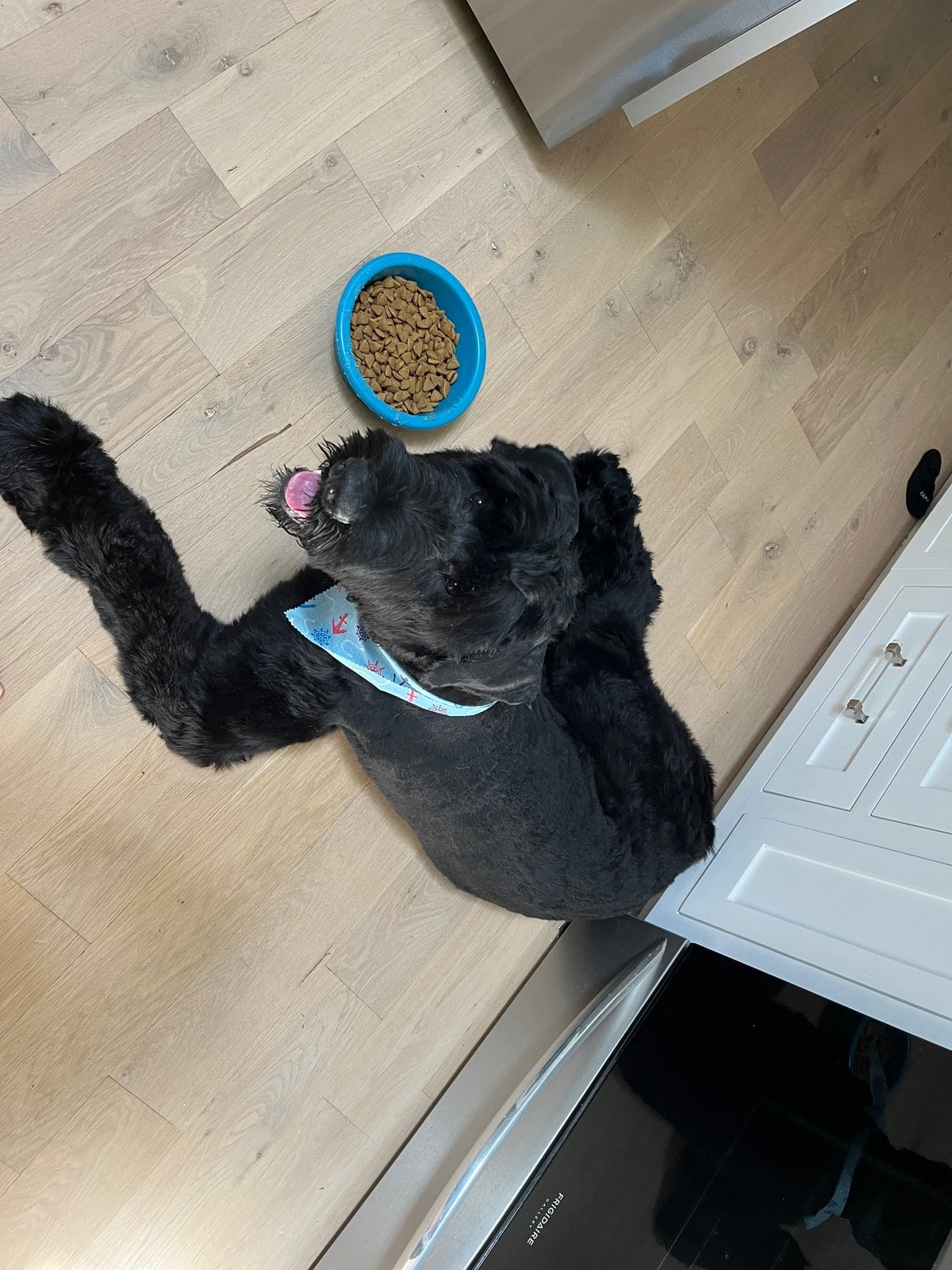
Day three of chicken diplomacy, and we have created a monster. A polite monster, but still. Now that the backyard contains actual chickens, Tuxedo has decided the yard is the most interesting place on the planet, and he would like to be out there supervising at all times. His current method of asking is to stand at the back door like a 105-pound statue and stare at the side of our heads until someone cracks. Sometimes there’s a single deep boof. It works, which is the problem — we’re rewarding the stare. So this week we hung seven dollars’ worth of jingle bells on the door handle and taught him to ask like a gentleman.
Why a bell beats the stare
The trouble with a dog’s natural “I need out” signals is that they’re easy to miss. VCA’s behavior team describes what to watch for — sniffing, circling, restlessness — and notes that some dogs simply pause what they’re doing right before the moment of truth [2]. Subtle. The AKC’s trainer makes the case for giving dogs a clearer channel: bell training lets a dog independently signal that they need to go outside, instead of scratching at the door, barking, or being missed entirely by whoever’s home [1]. The bell turns a guessing game into a doorbell. Anyone in the house — including guests who don’t speak fluent Schnauzer stare — knows exactly what that jingle means.
The training is almost embarrassingly simple
The AKC’s method is three steps [1]. First, let your dog investigate the bells and reward any interest — with the treat pouch from day one of this saga still on the belt, that part took Tuxedo about ninety seconds. Second, hang the bells on the door you use for potty trips, and ring them yourself every single time you take the dog out. The AKC’s point here is that dogs are always observing and learning from us — your dog watches you ring, then go outside, and connects the dots [1]. Third, the handoff: when your dog rings the bell on their own, praise generously and take them out immediately, every time [1]. That immediate response is the whole contract. A bell that only works sometimes is a bell a smart dog stops using.
The $7 set that’s on our door
We went with the BLUETREE dog doorbells — $6.99 at the time of writing, rated 4.6 stars across 39,839 ratings, and the number one best seller in dog doorbells on Amazon [3]. It’s a simple nylon strap that hangs from the door handle with seven extra-large 1.4-inch bells, and the strap adjusts to three lengths so the bottom bells sit right at nose height [3]. For a giant breed, the big bells matter twice over: they’re loud enough to hear from across the house, and they’re sturdy enough that an enthusiastic nose-bump doesn’t send tiny bells skittering across the floor.
The honest catches
- The bell is a contract, and the dog holds you to it. The AKC’s rule — ring means go out, immediately, with praise — cuts both ways [1]. If you ignore rings, the bell dies. Budget for some inconvenient trips to the yard in week one.
- A smart dog will discover the chicken-TV remote. Ours did, by day two. The bell means “outside,” and a dog with poultry to supervise will use it liberally. Our compromise: every ring earns a trip out, but boring rings get a short, businesslike lap — the party stays indoors.
- It doesn’t replace a schedule. VCA’s team is clear that dogs need regular breaks tied to meals, naps, and play regardless of any signaling system [2]. The bell is a communication tool, not a substitute for routine.
- Reward outside, not at the door. VCA recommends quiet praise and a small treat right where the business happens, outdoors — rewarding back inside teaches the wrong end of the sequence [2].
Buyer checklist for dog doorbells
- Bells big and loud enough to hear from another room — tiny craft bells get lost under a big dog’s nose [3]
- Adjustable strap length so the bottom bells hang at your dog’s nose height [3]
- Sturdy stitching and thick strap — a giant breed’s ring is not gentle [3]
- Hung on the one door you actually use for potty trips, so the association stays clean [1]
- A loaded treat pouch nearby for the first week of reps — interest in the bell gets paid [1]
- A house rule everyone follows: ring means out, every time, or the system falls apart [1]
Sources
- American Kennel Club (Sassafras Patterdale, CPDT-KA, CTDI) — Dog Bell Training: Teach a Dog to Ring Bell to Go Outside: https://www.akc.org/expert-advice/training/teach-dog-ring-bell-go-outside/ (accessed 9/18/2026)
- VCA Animal Hospitals (Ellen Lindell, VMD, DACVB; Monique Feyrecilde, BA, LVT, VTS (Behavior)) — House Training Your Puppy: https://vcahospitals.com/know-your-pet/house-training-your-puppy (accessed 9/18/2026)
- Amazon product listing — BLUETREE Dog Doorbells for Potty Training (7 extra-large 1.4″ bells, 3-level adjustable strap): price, rating, review count, best-seller rank, and product claims as of 9/18/2026
Leave a Reply