This post contains affiliate links. If you buy through them, we may earn a small commission at no extra cost to you. It helps keep Tuxedo in tennis balls.
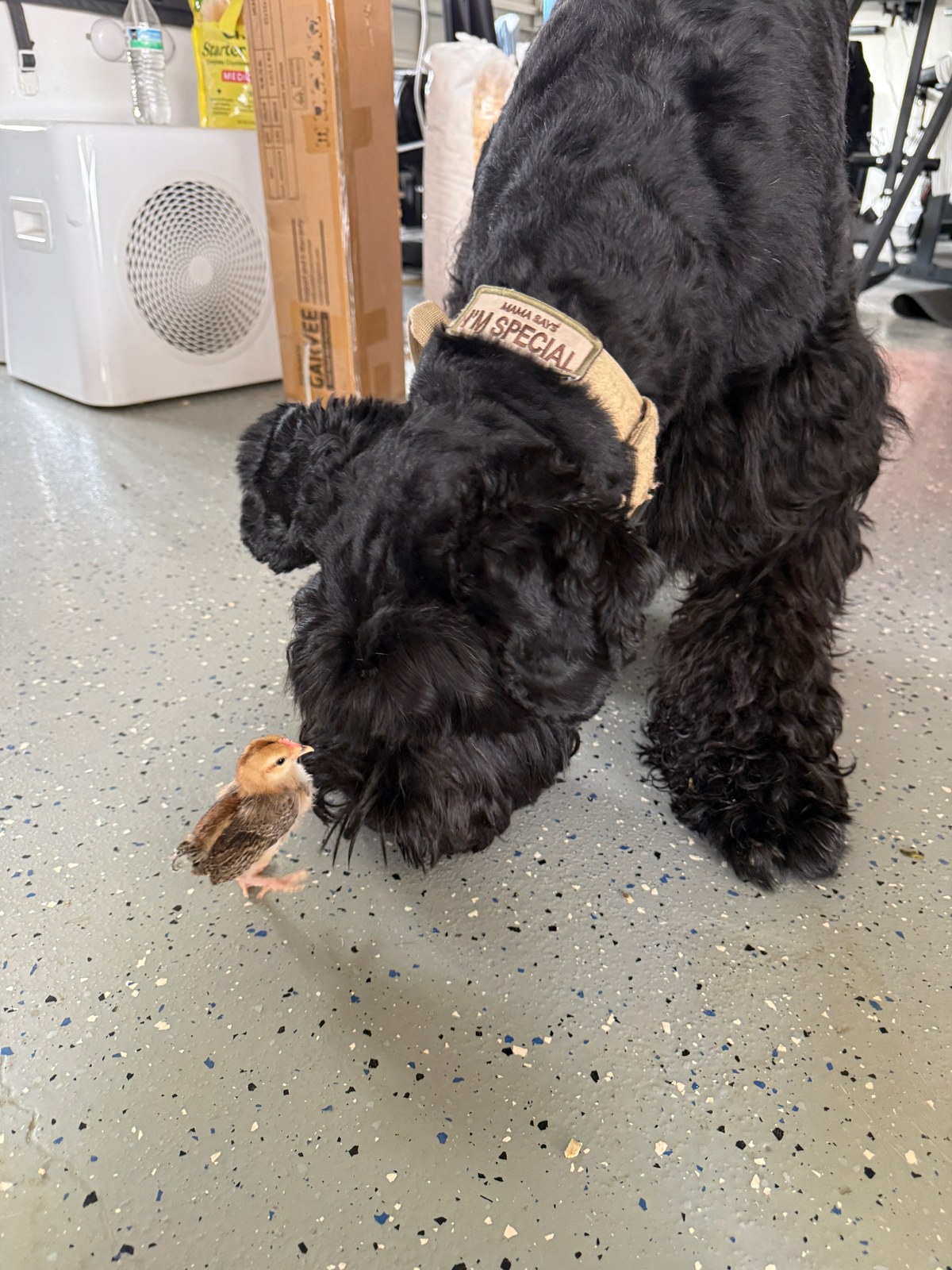
Big news at our house: chickens. Actual chickens, walking around the backyard like they pay rent. Tuxedo — 105 pounds of Giant Schnauzer bred specifically to run a farm — has taken this development personally. He currently spends a portion of every morning at the window, supervising. Which means we’ve started the most important training project of his career: being calm and polite around birds his ancestors were hired to manage. And the first thing that training exposed wasn’t a gap in Tuxedo. It was a gap in us — fumbling treats out of a sandwich bag five seconds too late. The fix, it turns out, costs thirteen dollars.
Training is a timing game, and pockets lose it
The AKC’s training guidance is blunt about the mechanic that makes reward training work: deliver the reward as quickly as possible after the behavior, because if you take too long, the dog can become confused about what exactly they’re being rewarded for [1]. Picture it with a chicken on the other side of the fence: Tuxedo looks at the bird, then chooses to look back at us — that half-second glance is the behavior we’re paying for. If the treat arrives while he’s already lunging at the fence line, we just bought the wrong behavior. The AKC’s writer puts it plainly: it takes practice and planning to deliver treats quickly and accurately in the right location [1]. A zip-top bag in a jeans pocket is neither quick nor accurate. Ask us how we know.
You need more treats than you think
The second mechanic is frequency. In the AKC’s heeling example, one treat every 15 steps won’t make an impact — but one treat for every step keeps the dog engaged, because your rewards have to make you more exciting than the environment [1]. Our environment is live poultry. We are competing with the single most interesting thing Tuxedo has ever seen. That means a high rate of small rewards, which means carrying a real supply of them somewhere a hand can reach in under a second — not a crinkly bag that announces itself and then refuses to open.
The 10% rule keeps it honest
Before anyone worries about a dog earning forty treats before breakfast: VCA’s veterinary nutrition team has a hard guideline. Keep calories from treats within 10% of your dog’s total calorie intake — their example: a dog on 550 calories a day gets at most 55 from treats [2]. Their advice for training specifically is treats that break into many small pieces, small kibble, or low-calorie treats, so you can reward frequently without blowing the budget [2]. This is also the quiet argument for a pouch: pea-sized soft treats and loose kibble are exactly the things you cannot manage from a pocket.
The $13 pouch that fixes the fumble
The best-reviewed option we found is the eBasics Dog Treat Pouch — $12.99 at the time of writing, rated 4.7 stars across 4,467 ratings [3]. Full transparency: we researched this one and it’s joining the chicken-diplomacy program this week; the field report will follow.
Why it matches what the sources describe: the closure is a magnet with a cord-pull, built for one-handed open-and-close — that’s your reward speed [3]. The main compartment is roomy and ergonomically shaped with a black interior lining so you can actually see the treats you’re grabbing [3], which sounds trivial until you’re trying to find a brown treat in a brown bag while a chicken struts past. It wears hands-free on a waist clip or belt — one leash, one dog, zero spare hands — and there’s a zippered front pocket — 4.5 inches wide by 3.5 high — for the phone or the poop bags [3]. None of this is exotic technology. It’s just the difference between rewarding the glance and rewarding the lunge.
The honest catches
- The pouch trains you, not the dog. It fixes delivery speed and supply — the human half of the equation. The dog half is still short sessions, distance from the distraction, and patience.
- Don’t become a vending machine. If the treats only ever appear when the pouch is on, a smart dog notices. Vary where rewards come from, and keep sessions unpredictable enough that the pouch isn’t the cue.
- Count the calories anyway. A pouch makes rewarding easy — which makes over-rewarding easy. The 10% treat budget still applies on training days [2]; use part of the daily kibble ration as the filler rewards.
- A pouch is not a livestock guarantee. A working-breed dog around poultry needs managed introductions and supervision, full stop. The pouch buys you clean training mechanics — the fence and your judgment do the safety.
Buyer checklist for a dog treat pouch
- One-handed closure (magnetic beats zippers and drawstrings for speed) [3]
- Hands-free wear — belt clip or waistband — so the leash hand stays on the leash [3]
- Big enough opening for a full grab without looking [1][3]
- Small, soft, low-calorie treats inside — many pieces, not big biscuits [2]
- Treats capped at 10% of daily calories — swap in kibble for the routine reps [2]
- A plan for what you’re rewarding — the fast glance back at you, not the excitement at the fence [1]
Sources
- American Kennel Club (Stephanie Gibeault, MSc, CPDT) — 4 Tips for Training Your Dog With Rewards: https://www.akc.org/expert-advice/training/training-rewards/ (accessed 9/16/2026)
- VCA Animal Hospitals (Rebecca Hunt, RVT, VTS (Nutrition); Sarah Wilson, BScH, DVM, DACVIM (Nutrition)) — Using Food and Treats for Training Dogs: https://vcahospitals.com/know-your-pet/using-food-and-treats-for-training-dogs (accessed 9/16/2026)
- Amazon product listing — eBasics Dog Treat Pouch for Training (magnetic closure, waist clip): price, rating, review count, and product claims as of 9/16/2026
Leave a Reply