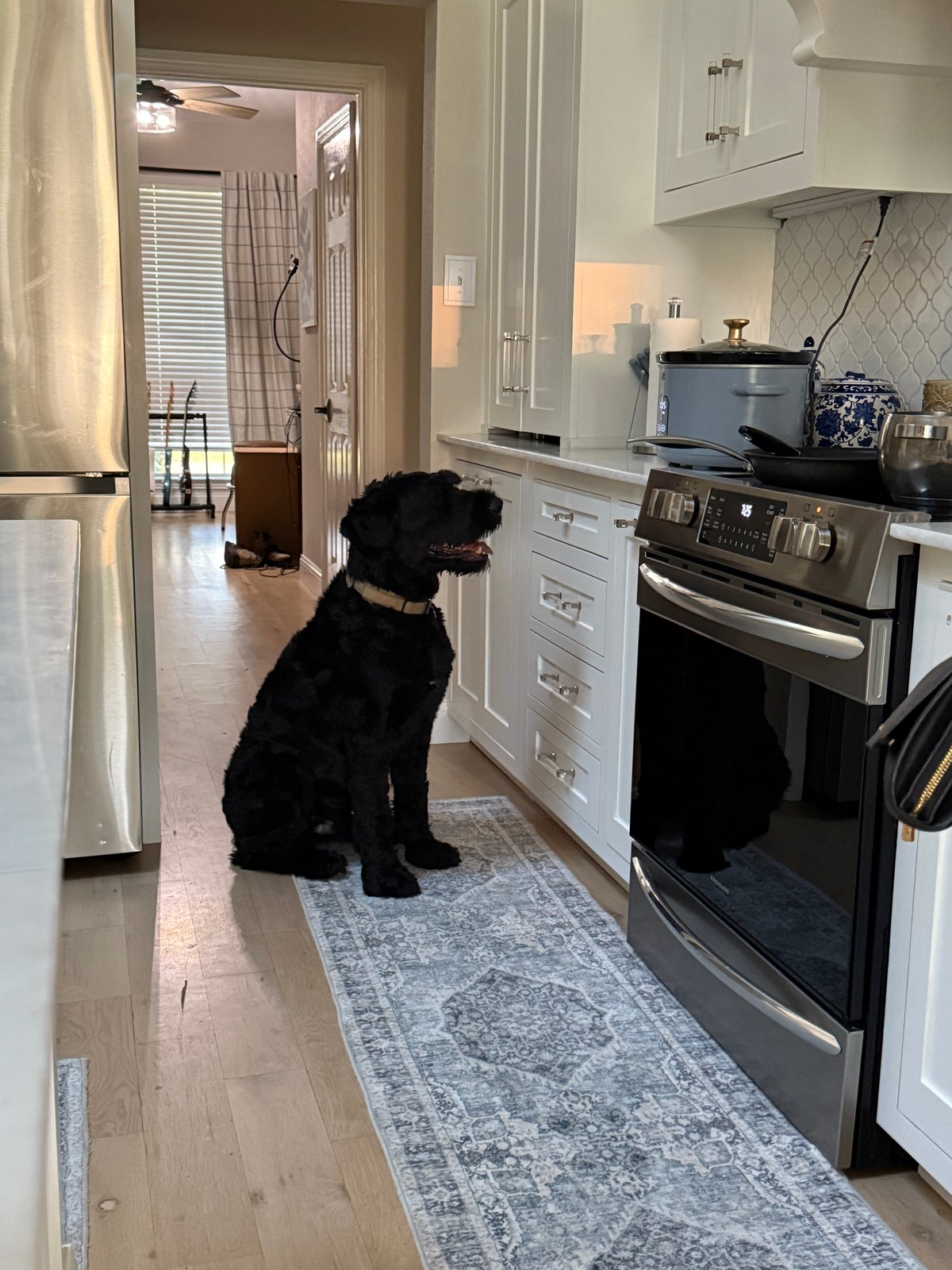
This post contains affiliate links. If you buy through them, we may earn a small commission at no extra cost to you. It helps keep Tuxedo in tennis balls.
Every big-dog owner eventually goes hunting for the mythical chew that lasts longer than four minutes. For a 105-pound Giant Schnauzer with jaws built for farm work, most “long-lasting” chews are an appetizer. Bully sticks are the internet’s favorite answer — single ingredient, no rawhide, dogs lose their minds for them. But when we did the actual reading, we found something worth knowing before you order: the veterinary sources don’t fully agree on them. Here’s the honest version — what they are, what the research says, and how to use them safely if you decide they’re right for your dog.
First, what a bully stick actually is
Fair warning if you didn’t know: bully sticks are dried bull pizzle — and in the Tufts veterinary study that looked at these treats, nearly half of surveyed dog owners had no idea [1]. The upside of that single-ingredient origin is real: no rawhide, no grain, no mystery meat slurry — just one dried beef muscle, which is why they’re marketed as fully digestible and why dogs treat them like currency.
What the Tufts researchers found
Researchers at Tufts’ veterinary school (Freeman, Janecko, and Weese, published in the Canadian Veterinary Journal) measured what’s actually in these treats. Two findings matter for a big-dog house. First, calories: bully sticks run 9 to 22 calories per inch — a typical 6-inch stick is roughly 100 calories, and half of owners underestimated that [1]. A 12-inch stick for a giant breed can push 200+ calories, which is a real dent in the daily budget even for a 105-pound dog, and more than half of U.S. dogs are already overweight [1]. Second, bacteria: of 26 sampled sticks, several carried E. coli, one carried C. difficile, and one carried MRSA [1]. Their advice isn’t “never” — it’s wash your hands after handling, and keep raw animal-based treats away from high-risk people (very young, elderly, pregnant, immunocompromised) [1].
Where vets disagree: the tooth question
Here’s the part most bully stick articles skip. VCA’s veterinary dentistry guidance on fractured teeth recommends eliminating hard, non-bending chews — and its list names bones, antlers, cow hooves, nylon chews, and pizzle sticks [2]. A fractured tooth is no small thing: once the nerve is exposed, bacteria hide inside the root canal where the immune system can’t clear them, causing pain every time the dog chews [2]. VCA’s practical test is simple: throw out chews or toys that do not readily bend [2]. Bully sticks are softer than antlers and soften further as they’re chewed, but a fresh thick stick is firm — which is why dental specialists are more cautious about them than the marketing is. If your dog has already chipped a tooth on hard chews, this category probably isn’t for them.
If you buy them, buy them like this
The best-reviewed option we found is Natural Farm Odor-Free Bully Sticks (12-inch, 5 count) — $29.98 at the time of writing, rated 4.5 stars across 15,533 ratings and sitting at #1 in Bully Stick Dog Treats [3]. The listing’s claims line up with what you want in this category: 100% grass-fed beef and nothing else — grain free, hormone free, chemical free — processed in a USDA-certified food-grade facility, slow oven-baked, and odor-free, which anyone who has smelled the cheap ones will appreciate [3]. The 12-inch length is the right call for a giant breed: a stick your dog can’t fit fully in their mouth. Full transparency: we researched this one; given Tuxedo’s tooth-cracking enthusiasm, we’re introducing it with the supervision rules below and will report back.
The honest catches
- The end piece is the hazard. The last few inches are a gulp-and-choke risk for a big dog who inhales the remainder whole. Take the stub away, or use a bully stick holder that forces slow chewing to the end.
- Count it like food, because it is. At 9–22 calories per inch [1], a 12-inch stick can be a fifth of a big dog’s daily calories. Feed a little less kibble on bully stick days.
- Treat it like raw meat in the house. Wash your hands after handling, and don’t let the baby crawl where the stick has been — the Tufts samples carried real pathogens [1].
- Know the dental dissent. VCA’s dental guidance lists pizzle sticks among chews to avoid for fracture risk [2]. If your dog is a jaw-strength outlier or has any dental history, ask your vet first — and for pure dental benefit, VOHC-accepted products are the safer lane [2].
- Supervised only. Every source lands in the same place: this is a sit-nearby treat, not a leave-for-the-day treat.
Buyer checklist for bully sticks
- Single ingredient — 100% beef pizzle, nothing added [3]
- Sized up: 12-inch sticks for a large or giant breed, never ones that fit fully in the mouth [3]
- A plan for the end piece — take it away or use a holder
- Calories counted into the daily ration — 9–22 per inch [1]
- Hand washing after handling, and none in high-risk households [1]
- A vet conversation first if your dog has ever chipped or fractured a tooth [2]
Sources
- Tufts Cummings Veterinary Medical Center, Petfoodology (citing Freeman LM, Janecko N, Weese JS, Canadian Veterinary Journal 2013;54:50-54) — Dangers of Bully Sticks: https://sites.tufts.edu/petfoodology/2018/11/01/dangers-of-bully-sticks-popular-treat-can-carry-bacteria-and-add-calories/ (accessed 9/13/2026)
- VCA Animal Hospitals — Fractured Teeth in Dogs: https://vcahospitals.com/know-your-pet/fractured-teeth-in-dogs (accessed 9/13/2026)
- Amazon product listing — Natural Farm Odor-Free Bully Sticks (12 in, 5 ct): price, rating, review count, category rank, and product claims as of 9/13/2026
Leave a Reply