
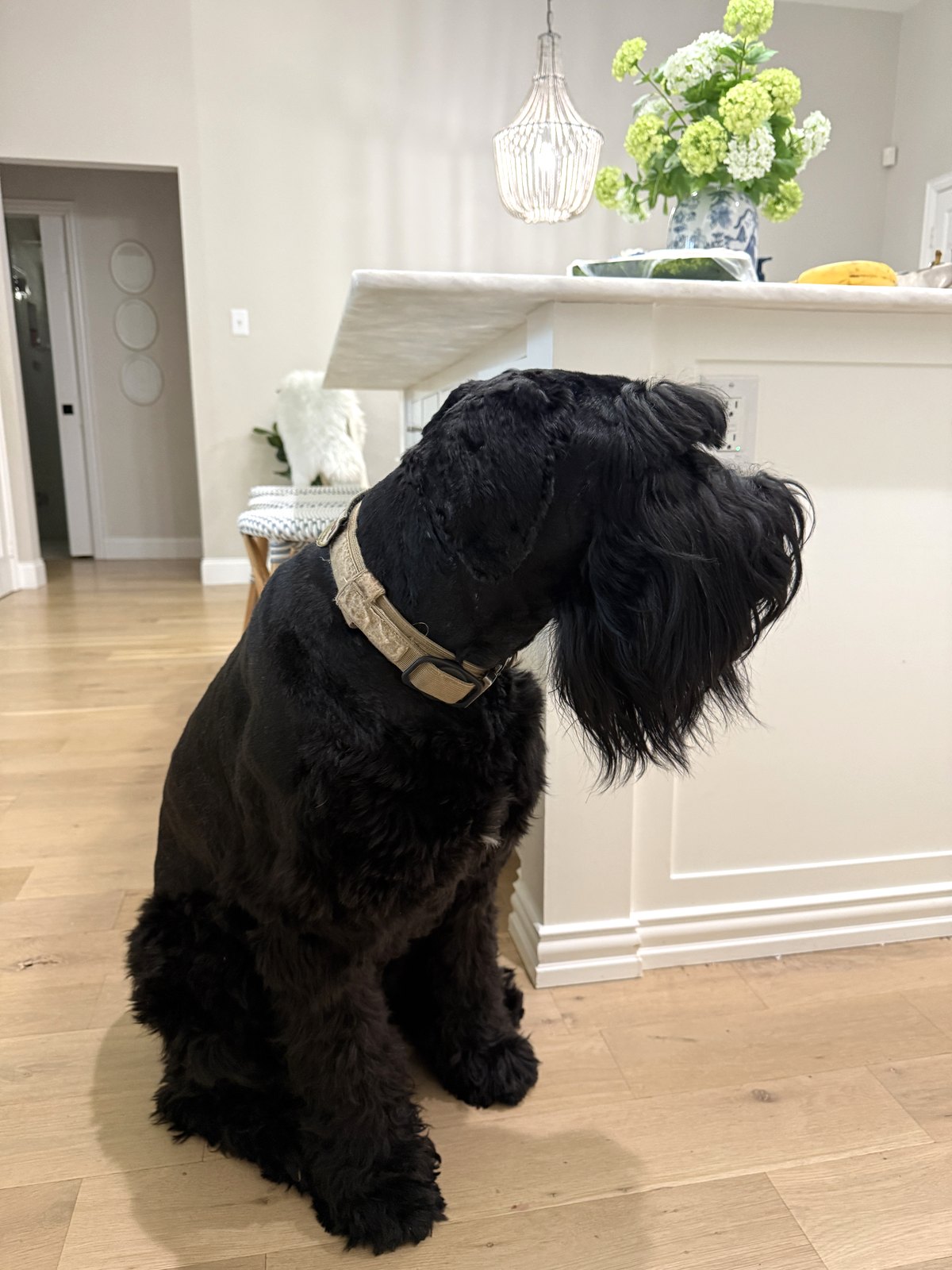
This post contains affiliate links. If you buy through them, we may earn a small commission at no extra cost to you. It helps keep Tuxedo in tennis balls.
Feeding a 105-pound Giant Schnauzer means buying kibble the way restaurants buy flour: in enormous bags that take weeks to empty. And that’s the trap. Every day that bag sits open, air is working on the fat in the food — and every day it sits within reach, a big smart dog is working on a plan to get into it. We looked into what the FDA and veterinary nutritionists actually say about storing dog food, and the biggest surprise was this: the way most owners use a storage container is exactly the way the experts say not to.
Kibble has two enemies, and one of them is air
Dry food feels indestructible, but it isn’t. The AKC’s veterinary sources explain that once a bag is opened, the fats in kibble begin oxidizing on contact with air — lipid oxidation that breaks down fats, turns them rancid, and damages the essential fatty acids your dog is supposed to be getting [1]. Rancid food can also mean GI upset and diarrhea, and dogs often smell the problem before we do — a dog suddenly reluctant to eat his usual food is a classic sign [1]. As veterinary nutritionist Dr. Larsen puts it in the AKC piece, air and light are the enemies of stored food [1].
The FDA adds the environmental half: store dry food somewhere cool and dry, below 80°F, because excess heat or moisture can cause the nutrients themselves to break down [2]. A garage in Texas in September does not qualify — a fact we learned the hard way about many things.
The whole-bag rule most owners break
Here’s the counterintuitive part. The standard move — tear open the bag, pour fifty pounds of kibble into a plastic bin — is the one both sources warn against. The FDA’s guidance is to keep food in its original bag, and if you use a container, to put the entire bag inside it rather than pouring the kibble in loose [2]. The AKC’s veterinary experts agree: transferring kibble out of its packaging exposes it to more air and light [1].
The bag matters for two reasons. First, it’s engineered as a fat barrier in a way a plastic bin isn’t. Second, it carries the UPC, lot number, and expiration date — and the FDA notes that fewer than half the pet food complaints it receives include a lot number, which is the one piece of information that matters most in a recall [2]. Keep the bag, and you keep the paper trail.
The container built for the whole-bag method
So the job description changes: you don’t need a bin to hold loose kibble — you need an airtight vault big enough to swallow a giant-breed bag whole. The one we picked for Tuxedo’s food is the IRIS USA 54-lb airtight dog food container — $35.99 at the time of writing, rated 4.4 stars across 6,698 ratings [3]. Full transparency: we researched this one and just ordered it; long-term review to come.
Why it fits the expert criteria: it holds up to 54 pounds of food, which means a full large-breed bag goes in still sealed in its own packaging; the airtight gasket and snap-lock latches keep out the moisture and humidity the FDA warns about — and keep out the dog, which with a food-motivated problem-solver is not a theoretical concern [2][3]. It’s BPA-free, rolls on attachable wheels (fifty pounds of kibble moves exactly once without them), and keeps a 2-cup scoop in the lid so portions stay consistent [3].
The honest catches
- A latched bin is not dog-proof, it’s dog-resistant. A determined giant breed can knock over almost anything. Ours lives behind a pantry door; the latches are the second line of defense, not the first.
- Wash it between bags. The FDA says to clean storage containers between refills — old fat residue in the bin goes rancid and contaminates the fresh bag [2]. This is the chore everyone skips.
- It won’t fix a too-big bag. If your dog takes two months to finish a bag, the food is oxidizing inside it no matter what it’s stored in. Buy the bag size your dog finishes in a few weeks [1].
- Location still matters. Airtight doesn’t beat a 100-degree garage — cool and dry, under 80°F, per the FDA [2].
Buyer checklist for a big-dog food container
- Big enough to hold your full bag — still inside its original packaging [1][2]
- A true airtight gasket with latches, not just a press-on lid [2]
- Wheels if you buy 40+ lb bags — the container you can move is the one that stays where food should be stored
- A dedicated scoop that lives with the container, washed regularly like a food bowl [2]
- A wash-between-bags habit, and a cool indoor spot under 80°F [2]
Sources
- American Kennel Club — Does Dog Food Expire? How to Know If Your Pet’s Food Has Gone Bad: https://www.akc.org/expert-advice/nutrition/does-dog-food-expire/ (accessed 9/3/2026)
- U.S. Food & Drug Administration — Proper Storage of Pet Food & Treats: https://www.fda.gov/animal-veterinary/animal-health-literacy/proper-storage-pet-food-treats (accessed 9/3/2026)
- Amazon product listing — IRIS USA Dog Food Storage Container (up to 54 lbs): price, rating, review count, and product claims as of 9/3/2026
Leave a Reply